Skip to content
07 / 08

BTC Lights

A free, public Bitcoin trend reading: once a day, a score from 0 to 100, a traffic light and what the model holds, with a record of every reading that anyone can check. General information, not advice.

Public, non-commercial · 2026 · Python, Postgres, Cloud Run

Live since 17 November 2026 · public record

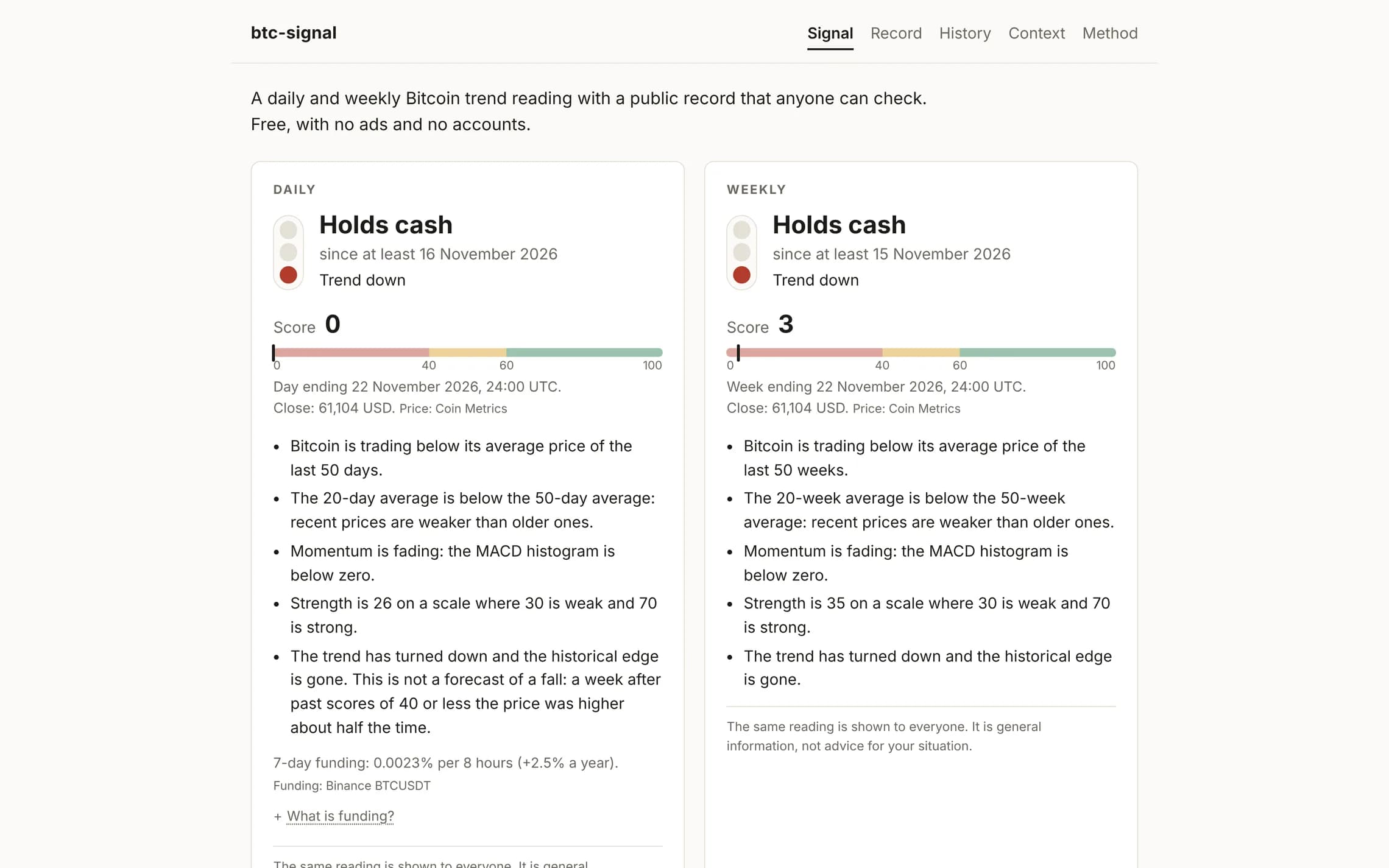
The daily and the weekly reading, each with its light, its score and the reasons in plain sentences.
Problem
The site introduces itself as “a daily and weekly Bitcoin trend reading with a public record that anyone can check”. The record is what it is built around: every reading is logged when it is published and is never changed.
Built
A daily and a weekly reading, just after 00:00 UTC · Score, light and holding, each with a fixed explanation in sentences · A record sealed reading by reading and timestamped in the Bitcoin blockchain · A check script visitors can run with Python 3 alone · A JSON API · No script, no cookies, nothing loaded from other sites
Stack
Python · FastAPI (uvicorn) · PostgreSQL (Supabase) · SVG charts drawn on the server · Google Cloud Run, with a daily job started by Cloud Scheduler · OpenTimestamps
Status
Live, with a public record since 17 November 2026. The method is at version 1.1: since 19 November the daily price comes from Coin Metrics instead of Kraken alone; the formulas and thresholds did not change, and earlier readings stay in the record as published.

The problem

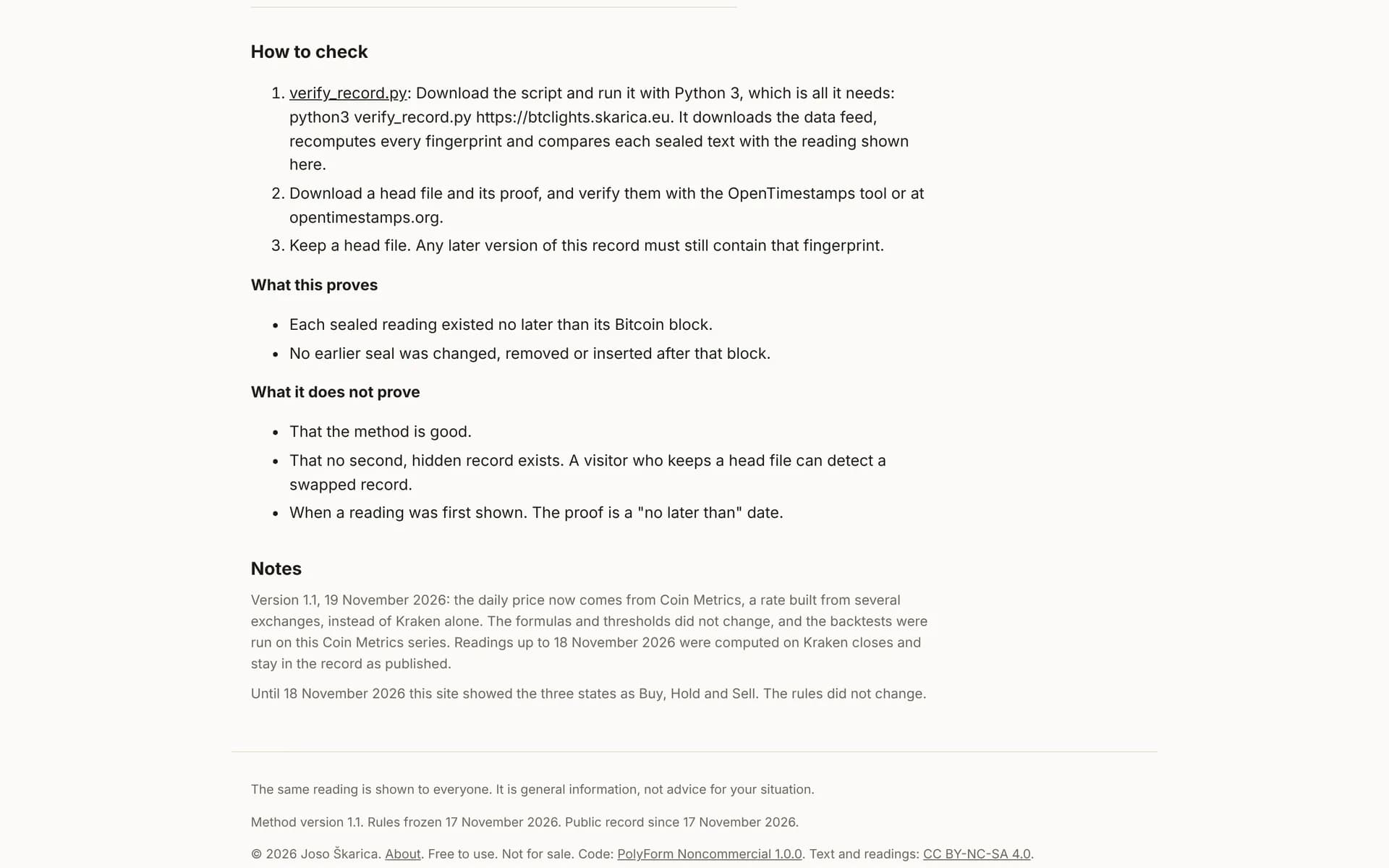
The score says whether Bitcoin’s trend currently favours holding or stepping aside. What the project is built around is its record, and the site says what that record proves: each sealed reading existed no later than its Bitcoin block, and no earlier seal was changed, removed or inserted after that block. It also says what the record does not prove, starting with this: that the method is good.

What I built

Once a day, just after midnight UTC, a job scores the completed daily and weekly bars and publishes a reading: a number from 0 to 100, a green, amber or red light, and what the model holds, Bitcoin or cash. Only completed bars are scored. If anything is missing, nothing is published and the page says “Data delayed”. Running the job twice publishes nothing the second time, and nothing stored is ever overwritten.

Each reading is sealed with a fingerprint that depends on every reading before it, and the newest fingerprint is timestamped in the Bitcoin blockchain through OpenTimestamps. The site serves a small script that needs only Python 3: it downloads the data feed, recomputes every fingerprint and compares each sealed text with the reading shown. The rules were frozen as version 1.0 on 17 November 2026, the day the public record began; any change is a new version with a date, and the method is written out in full on the site.

It is non-commercial: no subscription, no ads, no referral links and no donations. The same reading is shown to everyone, and the site says plainly what it is: general information, not advice. The code is under PolyForm Noncommercial 1.0.0, and the text and readings under CC BY-NC-SA 4.0.
The interface

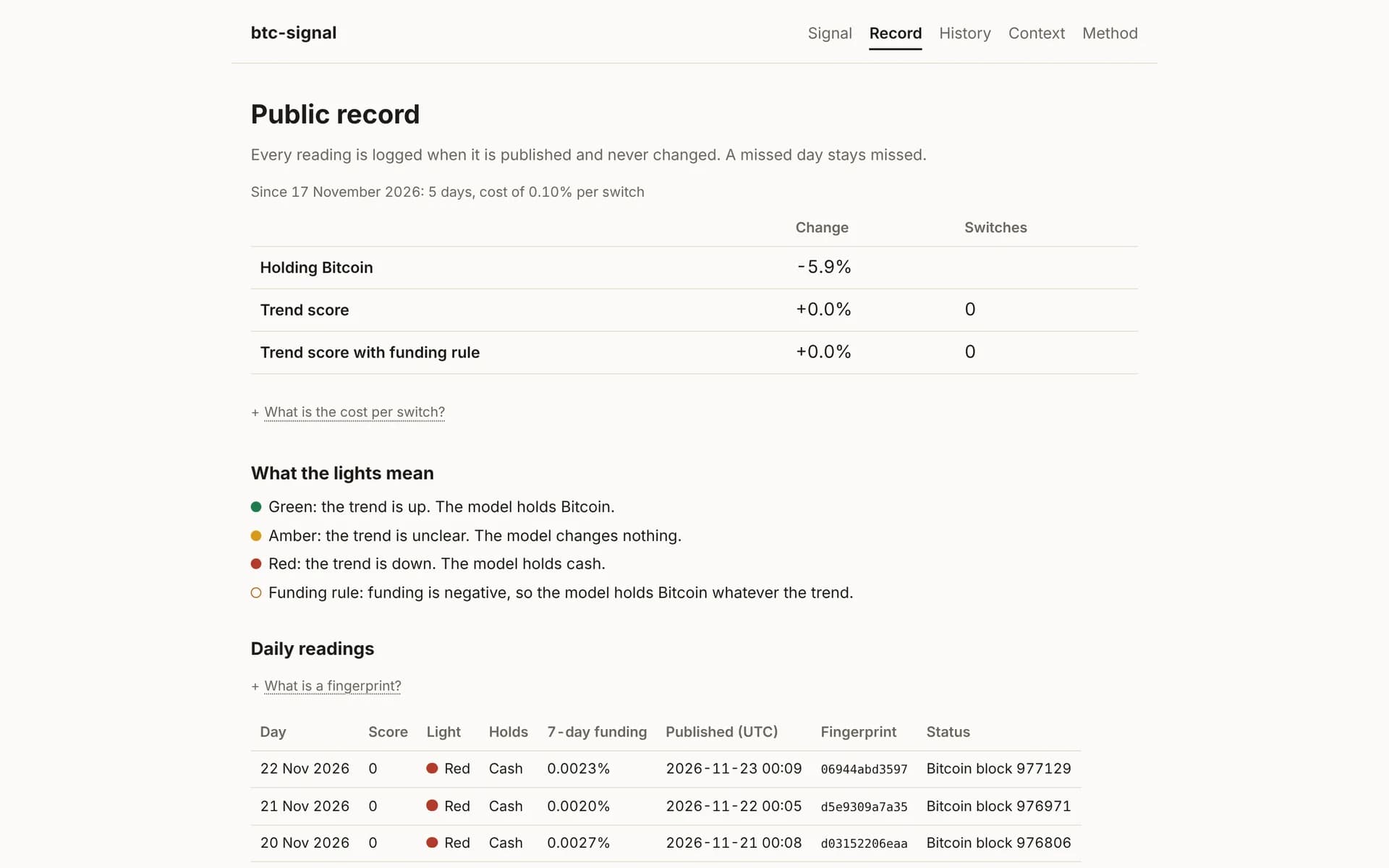
BTC Lights — The public record: every reading with its fingerprint and the Bitcoin block that timestamps it.
The public record: every reading with its fingerprint and the Bitcoin block that timestamps it.
BTC Lights — How to check the record: a script that needs only Python 3, what the record proves, and what it does not.
How to check the record: a script that needs only Python 3, what the record proves, and what it does not.
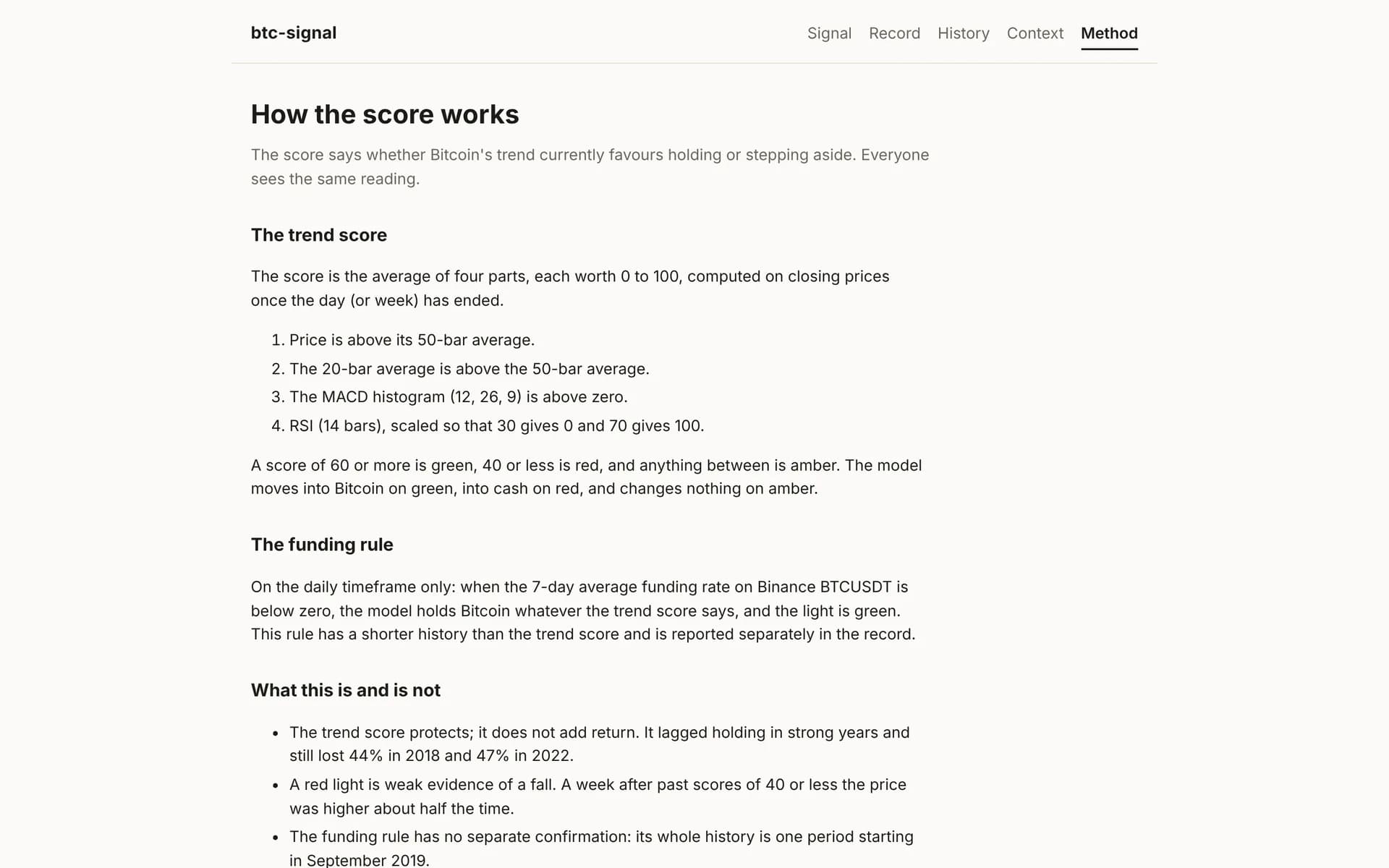
BTC Lights — The method, written out: the four parts of the score, the threshold for each light, and what the score is not.
The method, written out: the four parts of the score, the threshold for each light, and what the score is not.
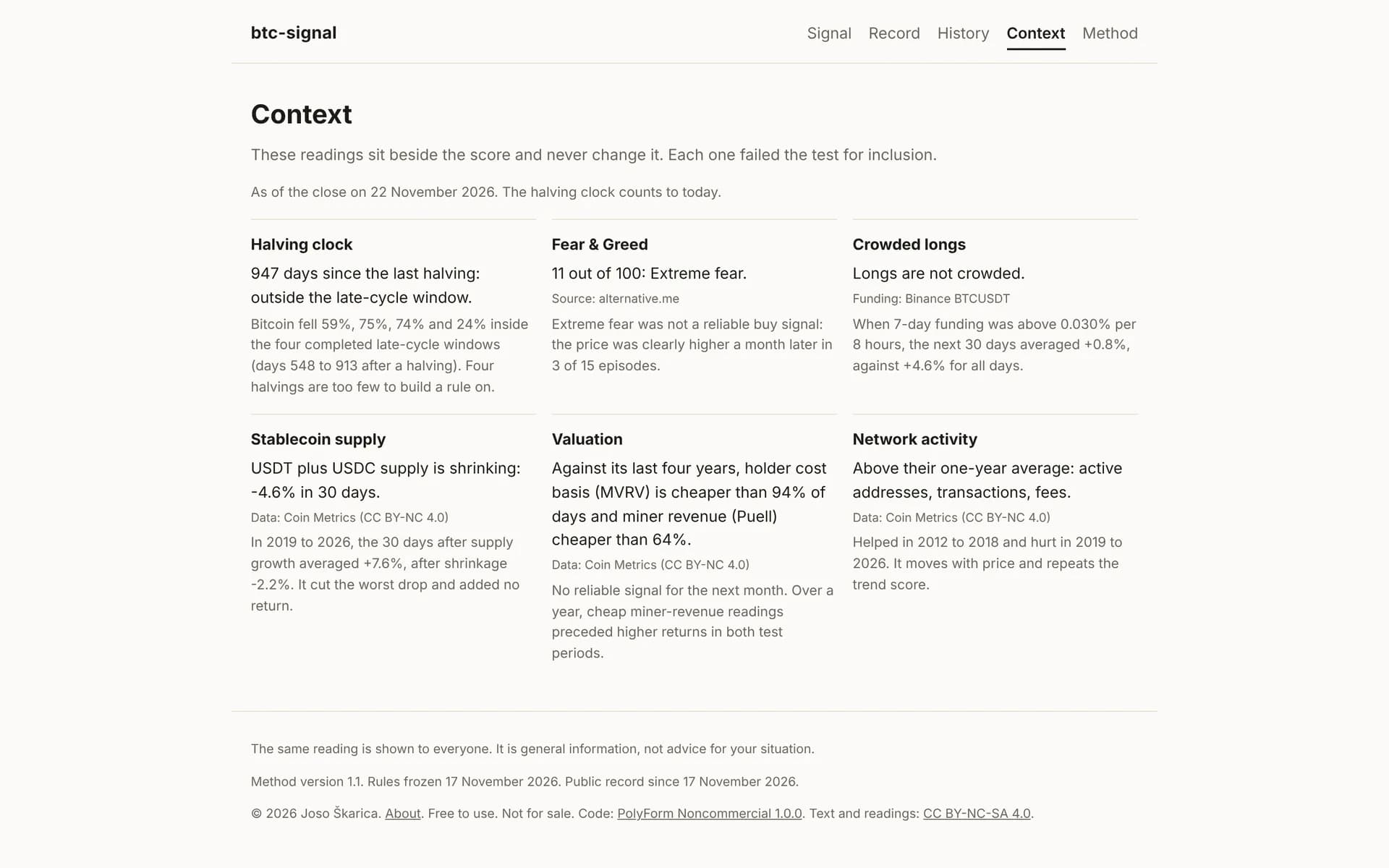
BTC Lights — Context: six readings that sit beside the score and never change it.
Context: six readings that sit beside the score and never change it.

Next case study

Kibitz →